“They Always Had Our Back”: One Family’s Journey Through Spinal Injury Care
The Start of Their Story
When Susan heard a loud thump from another room, she rushed through the door to find her husband unconscious on the floor.
“That was the start of a long life lesson and a huge change in life for both of us,” she recalls.
Her husband Michael, then 85, had sustained a severe spinal cord injury at their Hertfordshire home. The couple, who had spent decades building a life together, were suddenly facing something neither of them had any preparation for.
Getting the Right Start
Following his accident, Michael was transferred to Stoke Mandeville Hospital, Buckinghamshire, widely regarded as one of the leading centres for spinal injury rehabilitation in the country. The quality of that early specialist care proved critical to his recovery and to what came next.
After four months of rehabilitation, Michael was ready to come home. But that is when a different kind of challenge began. “We were told he’d be coming home in a few weeks, and I had no idea how to arrange care. No help at all,” says Susan. “You don’t know what you don’t know.”
It is a situation many families find themselves in. The clinical pathway ends, the discharge date arrives, and suddenly you are left to piece things together on your own.
“There should be a ‘how-to’ guide in every spinal hospital about arranging care,” Susan says. “Because there isn’t.”
The early attempts to find consistent, reliable support through other agencies were difficult. Continuity of care is everything when someone has complex needs, and achieving it is one of the hardest things families face when they first come home.
Where Abbots Care Made the Difference
When Michael and Susan turned to Abbots Care, things changed. A flexible package of live-in and overnight care was put together around Michael’s specific needs, covering everything from mobility and personal care to complex clinical routines. Crucially, the team around him stayed consistent. The same faces, the same approach, the same reliability.
For Susan, it was not just the practical support that stood out. It was the way every person involved, including our central support team, remained calm, approachable and steady throughout. When a family is under sustained pressure, that quality of care is not a small thing to us.
As Michael’s needs evolved over time, we at Abbots Care adapted. The care package grew and changed alongside him, always built around what he needed rather than what was easiest to provide.
We Are Here to Help
If you or someone you love has been affected by a spinal cord injury and you are not sure what comes next, our team is here to talk it through.
Get in touch with our team today or find out more about our specialist spinal injury care services and get in touch by calling 0330 094 5511 or emailing careservices@abbotscare.com
What Specialist Spinal Injury Care Involves
The needs of those with spinal injuries vary enormously; some may retain significant independence, while others with higher-level injuries, such as Michael, require fully delegated clinical care around the clock.
Abbots Care supports people across that full spectrum. Our care workers are trained in complex needs and in clinical areas including PEG feeding, advanced bowel and bladder care, non-invasive ventilation, and the management of serious complications such as autonomic dysreflexia. The training is led by our Community Nurse Assessor Katy, who works alongside our training team to ensure our care workers receive the best training in order to provide the best service to our clients.
The clinical capability matters. But so does the approach. As our CEO Camille Leavold explains, the focus is always on the individual behind the care plan.
“Spinal injuries affect every aspect of daily life, from mobility to complex medical needs. The right care is not just about practical support. It is about helping people feel in control again and live life on their own terms. Every spinal injury is different, which is why care must be built around the individual, their routines, their goals, and what matters most to them. Our focus is always on empowering independence, dignity, and confidence for both the individual and their family.”
The Role of the SIA Partnership
Here at Abbots Care, we are a trusted partner of the Spinal Injuries Association and one of only eight specialist care providers selected to take part in a new three-year programme designed to help people affected by spinal cord injuries find the right care and support at the right time.
That partnership matters in practical terms. The SIA provides a vital connection point for people like Michael and Susan who find themselves trying to navigate a complex system after discharge. Knowing that a care provider has been vetted, selected, and is working in collaboration with the UK’s leading spinal injury charity gives families a level of confidence that is hard to put a value on.
Six Years On
After more than six years at home, Michael eventually moved into a local care home. Abbots Care supported that transition too, including the handover to new staff, ensuring that the continuity which had defined his care at home carried through to the next chapter.
Susan’s reflection on the whole journey is simple and direct. “Nothing about it has been easy. But having the right people around them made all the difference.
For families facing a spinal cord injury, at any age and in any circumstance, that is exactly what Abbots Care and its partnership with the SIA is here to provide.
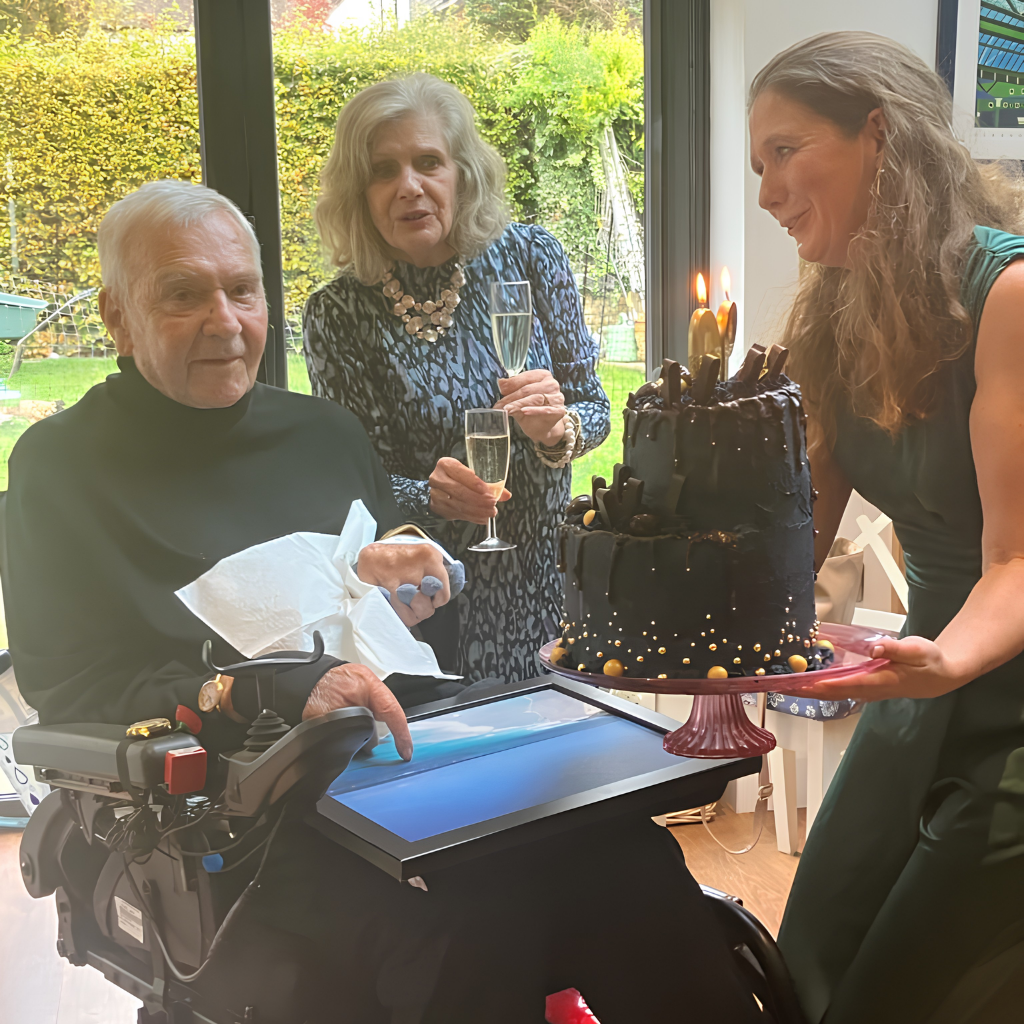
Michael, Susan, (left) and their daughter Katherine (right) on his 90th birthday.
Why This Matters Beyond One Family
Spinal cord injury does not only affect younger people. It can happen to anyone, at any age, including in an ordinary moment at home.
On Spinal Cord Injury Awareness Day, the Spinal Injuries Association is highlighting plans to transfer SCI service commissioning from national to local level by April 2027. The SIA is calling for specialist services to be protected across England and for an end to the postcode lottery that affects the standard of care people receive after injury.
Read More of Our News, Views or Insights